

What Companies Actually Hire Electronics and Communications Engineers?
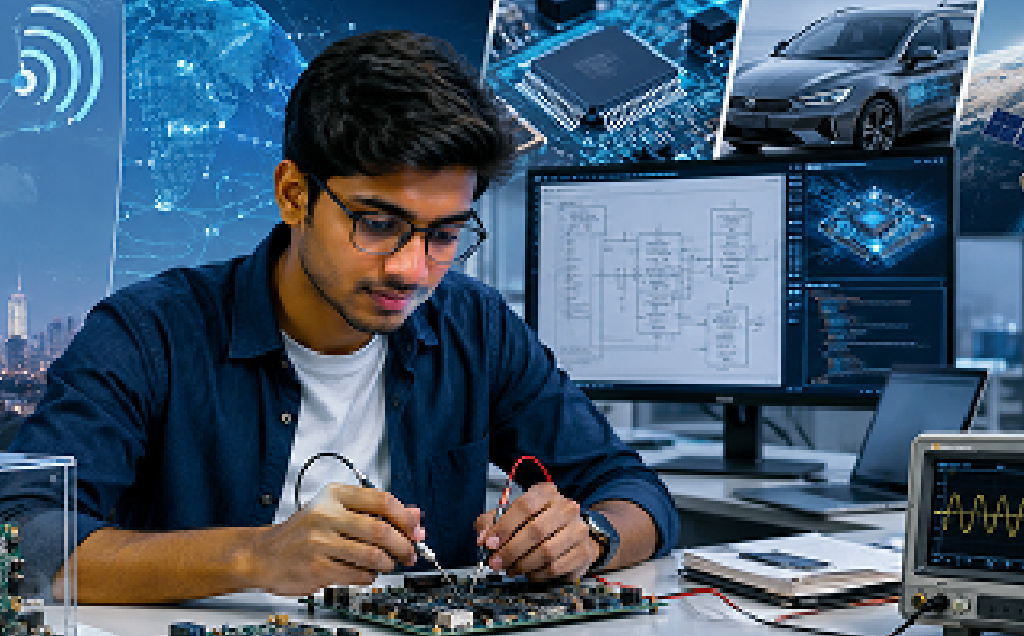
Ask most people what an ECE graduate does for a living and you’ll get a vague answer about “circuits” or “signals.” Ask an actual ECE graduate five years into their career, and you’ll get an answer involving chip design, telecom infrastructure, defence electronics, or a software role at a product company that has nothing to do with circuits at all. The branch has a strange reputation problem: it’s one of the most versatile engineering degrees in India, and almost nobody outside the field knows where its graduates actually end up.
Semiconductor and Chip Design Companies
This is where ECE’s most specialized and highest-paying opportunities sit. Global semiconductor companies including Intel, Qualcomm, Texas Instruments, MediaTek, and Samsung Semiconductor actively recruit ECE graduates for VLSI design, chip architecture, and hardware engineering roles, alongside Indian VLSI-focused firms like Tessolve, Sankalp Semiconductor, and Cadence and Synopsys, both major players in chip design software. India’s ongoing semiconductor manufacturing push has only intensified this demand, and cities like Bangalore and Pune have become genuine hiring hotspots specifically for semiconductor and embedded systems roles. Students aiming for this track usually strengthen their profile with a GATE score and often an M.Tech specialization in VLSI, since the most technically advanced roles in this space reward depth over a general ECE background.
Telecom and Communication Companies
This is the sector the “C” in ECE was originally built for, and it remains a major employer. Reliance Jio, Airtel, BSNL, and equipment and infrastructure companies supporting India’s telecom rollout hire ECE graduates for network engineering, signal processing, and communication systems roles. With 5G infrastructure still expanding across the country, communication-focused ECE graduates are stepping into a sector that’s actively building out capacity rather than a mature, slow-growing one.
Consumer Electronics and Hardware
Companies like Samsung, Philips, and a wide range of consumer electronics manufacturers hire ECE graduates for product design, hardware testing, and embedded systems development, the engineers responsible for the physical devices people use every day, from smart appliances to IoT-connected products. This sector has grown alongside India’s expanding electronics manufacturing base, and increasingly overlaps with software, since most modern consumer electronics run on embedded code as much as physical hardware.
Defence, Aerospace, and Government PSUs
This is where ECE offers something few other engineering branches can match: a genuinely stable, government-backed career path through Public Sector Undertakings. Organizations like Bharat Electronics Limited (BEL), Bharat Heavy Electricals Limited (BHEL), DRDO, ISRO, Hindustan Aeronautics Limited (HAL), Electronics Corporation of India Limited (ECIL), and the Airports Authority of India (AAI) recruit ECE engineers through GATE, offering exposure to national defence and space projects alongside the long-term job security PSU roles are known for. BEL specifically ranks among the most preferred recruiters for ECE graduates who want meaningful, mission-driven technical work with real stability attached.
GATE preparation is genuinely one of the highest-return paths available to an ECE graduate who doesn’t land their preferred role immediately after graduation. A strong GATE score opens PSU recruitment, M.Tech admission at IITs and NITs with a government stipend, and research roles at institutions like IISc and the IITs.
Software and IT Companies
Here’s the part that surprises people outside the field the most: a significant number of ECE graduates end up in software roles that look identical to what a computer science graduate does. Product companies including Qualcomm, Intel, and Texas Instruments
hire ECE graduates specifically for technically specialized software roles, embedded software development, firmware engineering, IoT development, roles that sit right at the intersection of hardware knowledge and coding skill. ECE graduates with strong programming ability in Python, C++, or Java are genuinely competitive candidates for these positions, often more so than a pure software background, because they understand the hardware layer their code eventually runs on.
Where the Real Demand Is Concentrated
A few cities have emerged as clear hiring hubs for specific ECE specializations. Bangalore leads for semiconductor and embedded systems roles. Hyderabad is strong for VLSI design and telecom. Chennai has built a strong automotive electronics sector. Pune has become a hub for IoT startups and chip design work. Knowing which city aligns with which specialization can meaningfully shape where a graduate chooses to focus their job search.
Government Exams Worth Knowing About
Beyond PSU recruitment through GATE, ECE graduates can pursue SSC JE in the Electronics stream, RRB JE for Signal & Telecom roles in the railways, and the UPSC Engineering Services Exam, all legitimate, well-regarded government pathways that specifically value an ECE background over other engineering branches.
The Real Takeaway
The honest answer to “what companies hire ECE engineers” isn’t a short list. It’s nearly every sector that touches hardware, communication, or embedded technology, which by 2026 covers an unusually wide slice of the Indian economy. What makes ECE genuinely distinctive isn’t any single employer. It’s the range: a student who specializes early in VLSI ends up in a completely different career than a classmate who leans into embedded software, and both are legitimately “ECE careers.”
KVELL’s B.E. in Electronics and Communications Engineering is built to expose students to this full range, core electronics, communication systems, embedded technology, and programming, early enough that students can figure out which direction genuinely interests them before they have to commit to a specialization.
More Blogs